Fundamentals
What "dispersed camping" actually means
A working definition of dispersed camping on U.S. public lands, how it differs from developed campgrounds, and the unwritten etiquette that keeps it legal.
A working definition
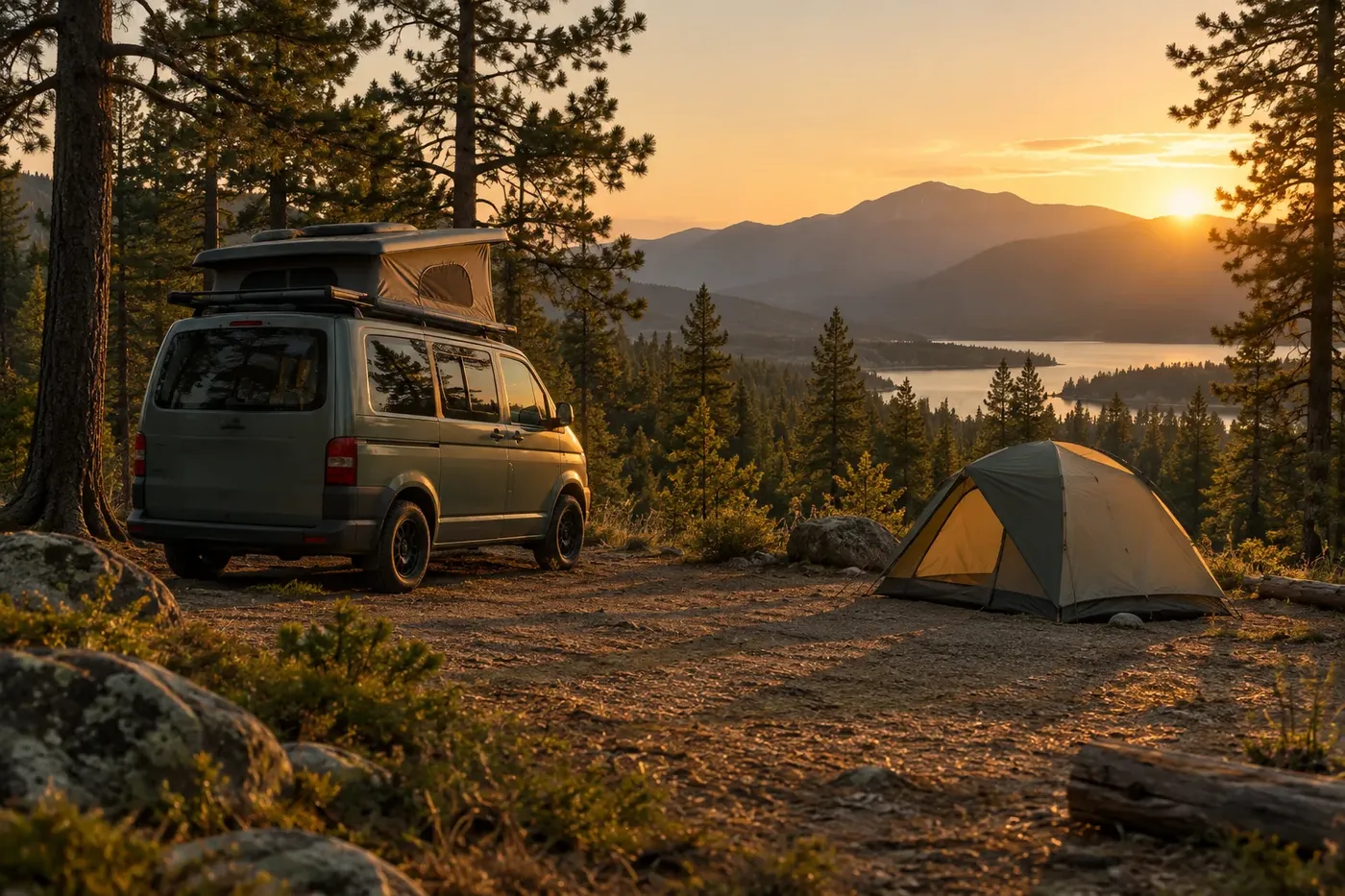
Dispersed camping is overnight camping on public land outside of a designated, developed campground. There are no numbered sites, no host, no spigots, no toilets, and no fee. You drive in on a road the agency has opened to motor-vehicle use, find a previously impacted clearing — what's called a 'pull-out' or 'spur' — and pitch your tent or park your van.
Most dispersed camping in the United States happens on land managed by the Bureau of Land Management (BLM) or the U.S. Forest Service (USFS). A small amount happens on state trust land, on certain National Park Service (NPS) backcountry permits, and on a handful of state-forest tracts. The rules vary by manager and unit, but the underlying contract is the same: you bring everything you need, you take everything out, and you camp lightly enough that the next person to use the spot can't tell you were there.
How it differs from a campground
A campground is a developed facility — graded sites, picnic tables, bear boxes, fire rings, vault toilets, sometimes potable water, and a campground host or self-pay station. Most campgrounds either accept reservations through Recreation.gov or operate first-come, first-served with a posted nightly fee.
Dispersed camping skips the development entirely. The trade-off is autonomy in exchange for self-reliance. You won't share a wall with a generator-running RV, but you also won't have anyone to call if your battery dies. The other major difference is stay limit: federal land typically caps you at 14 days in any 28- or 30-day window in the same general area, after which you have to move at least 25 miles.
The unwritten etiquette
Dispersed camping survives on public land because the people who use it largely behave themselves. The unwritten rules are simple. Camp on existing impacted ground, never on vegetation. Park at least one tire-track length away from the next clearing — the whole point is dispersal. Keep noise low after dark; sound travels much further than you think across an empty basin. Pack out toilet paper in a sealed bag, don't bury it. If you build a fire when fires are allowed, build it in an existing ring and burn it down to ash before you leave.
The biggest single threat to continued dispersed camping is closures driven by abuse — abandoned trash, illegal long-term residency, human waste, and wildfires started by neglected campfires. Every closure makes the remaining open land more crowded. The best thing you can do for the next generation of public-land campers is to leave each site noticeably cleaner than you found it.
Related guides
- BLM vs. USFS vs. state trust land — what actually changes — A side-by-side comparison of the three big public-land managers most dispersed campers will encounter, with the practical rules you need to know.
- Fire rules, fire pans, and the difference between Stage I and Stage II — How seasonal fire restrictions actually work on federal public land, and what each stage means for your camp stove, generator, and campfire.
- Water, waste, and the gallon-a-day rule — How much water to carry, how to handle gray water and human waste, and the small habits that keep dispersed sites usable for everyone.
- How to find a good dispersed pitch you can actually drive to — A practical field protocol for choosing a dispersed campsite from satellite imagery, motor-vehicle-use maps, and on-the-ground reading of the road.