Field skills
How to find a good dispersed pitch you can actually drive to
A practical field protocol for choosing a dispersed campsite from satellite imagery, motor-vehicle-use maps, and on-the-ground reading of the road.
Start with the right map
The two most useful planning tools are the relevant agency's motor-vehicle-use map (MVUM for USFS, Travel Management Plan for BLM) and a high-resolution satellite layer (Google Earth, CalTopo's USGS imagery, or Gaia GPS's satellite layer). The MVUM tells you which roads and spurs are legal to drive; the satellite imagery shows you which spurs actually have a turn-around and a flat clearing big enough for your vehicle.
Cross-referencing both is the fastest way to identify candidate sites without driving them. A spur road that ends at a 30-foot oval clearing visible from space is very likely an established dispersed site. A spur that disappears into trees with no visible clearing is probably an old skid road or a private easement.
Read the road
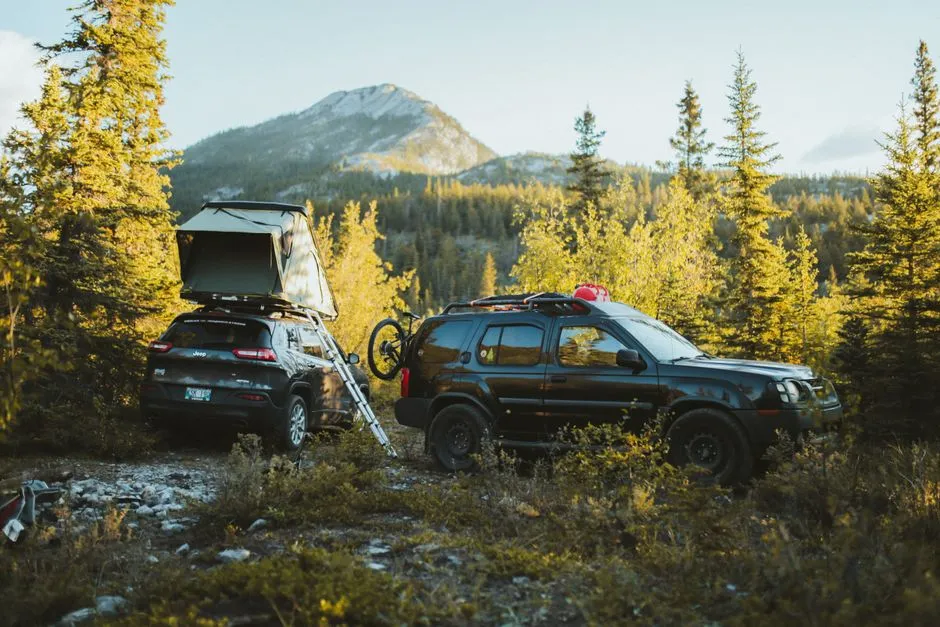
On the ground, the legal default on federal land is that you can pull off an open road into an existing clearing without driving any further off-road than the clearing requires. You cannot blaze a new spur, even a short one. If a clearing has been used before, you'll see compacted soil, an existing fire ring, and minimal vegetation. Use those.
Avoid drainages, low spots, and the bottoms of slopes — they collect water in storms and cold air at night. Pick a spot with at least one direction of clear sky for solar charging if you rely on it, and orient your tent so the door faces the prevailing morning sun for warmth and the prevailing afternoon wind for ventilation.
When to bail
If a road turns rough, muddy, or eroded beyond your vehicle's capability, turn around — even if you can see a perfect clearing 200 yards ahead. Getting unstuck on a remote spur road during a thunderstorm is a rescue-callout situation, and the agency tow bills are eye-watering. Always have a Plan B clearing identified back along your route, ideally one you've eyeballed on the way in.
Arrival window
The single best variable you control is when you arrive. Aim to be at your candidate clearing by mid-afternoon at the latest. That gives you light to look at two or three alternatives, time to set camp before dark, and margin to move if your first choice has water issues, sun issues, or a noisy neighbor. Showing up at sunset with no Plan B is how people end up sleeping in a Walmart parking lot or driving an unfamiliar dirt road in the dark — both worse than the original problem.
Related guides
- What "dispersed camping" actually means — A working definition of dispersed camping on U.S. public lands, how it differs from developed campgrounds, and the unwritten etiquette that keeps it legal.
- BLM vs. USFS vs. state trust land — what actually changes — A side-by-side comparison of the three big public-land managers most dispersed campers will encounter, with the practical rules you need to know.
- Fire rules, fire pans, and the difference between Stage I and Stage II — How seasonal fire restrictions actually work on federal public land, and what each stage means for your camp stove, generator, and campfire.
- Water, waste, and the gallon-a-day rule — How much water to carry, how to handle gray water and human waste, and the small habits that keep dispersed sites usable for everyone.